Language Learning

Japanese for Beginners

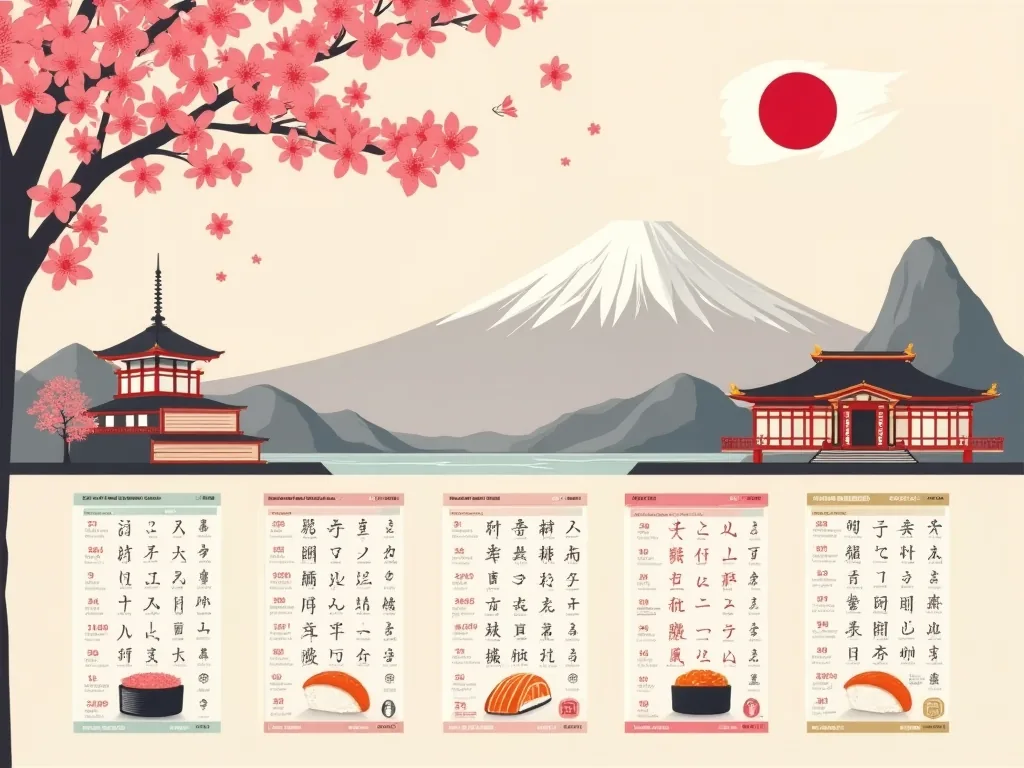
This study guide opens the door to Japanese by explaining hiragana and katakana, then introducing a first set of everyday kanji. Alongside the scripts, it covers basic sentence patterns, particles and polite verb forms, helping you read short passages, write simple sentences and understand the courtesy that shapes ordinary Japanese communication.

Levels
4
Starting from
265 credits
Category
Language Learning

About this study guide

Japanese uses three writing systems side by side, and this guide introduces them in a sensible order. It begins with hiragana, showing stroke order and the sounds of each character, before moving to katakana for foreign words and names. A small selection of common kanji follows, chosen because they appear constantly in signs, dates and everyday texts.

With reading underway, the material turns to grammar. You will learn how particles such as wa, ga, o and ni mark the role of each word, how verbs take polite masu forms, and how adjectives behave in different sentences. Practical vocabulary for greetings, time, food, transport and shopping is presented with example sentences written in Japanese script and romanised form.

Everything is organised across four levels, Beginner, Intermediate, Advanced and Expert, so you can build your reading and writing ability one layer at a time.
Each level is unlocked separately

Choose a level

Compare the levels below and add the one that suits you to your cart

01
Level 1

Beginner

265 credits

What this level includes
  • Covered in this level

    Covers all hiragana and katakana with stroke order, a first set of common kanji for numbers, days and people, and basic greetings. Grammar introduces the particles wa, ga, o and ni, the pattern X wa Y desu, and polite -masu verb forms in the present and negative.

  • Suited to

    This stage suits readers with no Japanese who want to learn the scripts properly from the very beginning. It is a good fit for anyone drawn to Japanese culture, travel or media who prefers a clear, step-by-step route through hiragana and katakana before grammar.

  • What you will be able to apply

    You will be able to read and write hiragana and katakana, recognise a handful of everyday kanji and introduce yourself politely. You should feel ready to form simple sentences about your daily activities and read short texts written mostly in kana.

02
Level 2

Intermediate

465 credits

What this level includes
  • Covered in this level

    This level explains the te-form and its many uses, plain and dictionary forms, the past tense in polite and plain speech, both types of adjective, and particles such as de, e, to and kara. It adds around a hundred more kanji and vocabulary for shopping, travel and work.

  • Suited to

    Aimed at readers who know the kana and basic polite sentences and want to use Japanese in more everyday situations. It suits those ready to tackle the plain form, the te-form and more kanji, which open up much more natural and varied expression.

  • What you will be able to apply

    After working through this stage you should be able to make requests, describe ongoing actions, talk about past experiences and give simple reasons. You will be able to read short notices and messages mixing kana and kanji, and write brief diary entries.

03
Level 3

Advanced

765 credits

What this level includes
  • Covered in this level

    The material covers keigo, including respectful sonkeigo and humble kenjougo, conditional forms with -ba, -tara, to and nara, passive and causative verbs, reported speech, and sentence-final particles such as yo, ne and no. Further kanji and compound words build reading stamina.

  • Suited to

    Designed for readers with a firm grasp of basic Japanese grammar who want to handle politeness and complex sentences. It suits those who can manage casual exchanges yet feel uncertain in formal settings or when reading longer texts.

  • What you will be able to apply

    You will be able to speak and write appropriately to superiors and strangers, express conditions and hypotheses, and describe events from different viewpoints. You should feel ready to read longer articles on familiar topics with the help of a dictionary.

04
Level 4

Expert

1,065 credits

What this level includes
  • Covered in this level

    Explores four-character yojijukugo idioms, advanced grammar patterns for nuance and concession, written styles such as the da and de aru forms, business email conventions, onomatopoeia, and subtle shades of politeness and indirectness. Extracts from essays, news and fiction show how writers shape tone.

  • Suited to

    This is the deepest level, intended for confident users of Japanese who want refinement and a natural command of register. It suits readers interested in literature, business correspondence or media who want their Japanese to feel precise, idiomatic and culturally attuned.

  • What you will be able to apply

    You should feel ready to move smoothly between casual, polite and formal Japanese, read demanding texts with attention to nuance and write polished pieces with a personal voice. You will be able to handle indirect expression and cultural subtext with confidence.

Levels are unlocked with credits from your balance. You can add more credits at any time.